
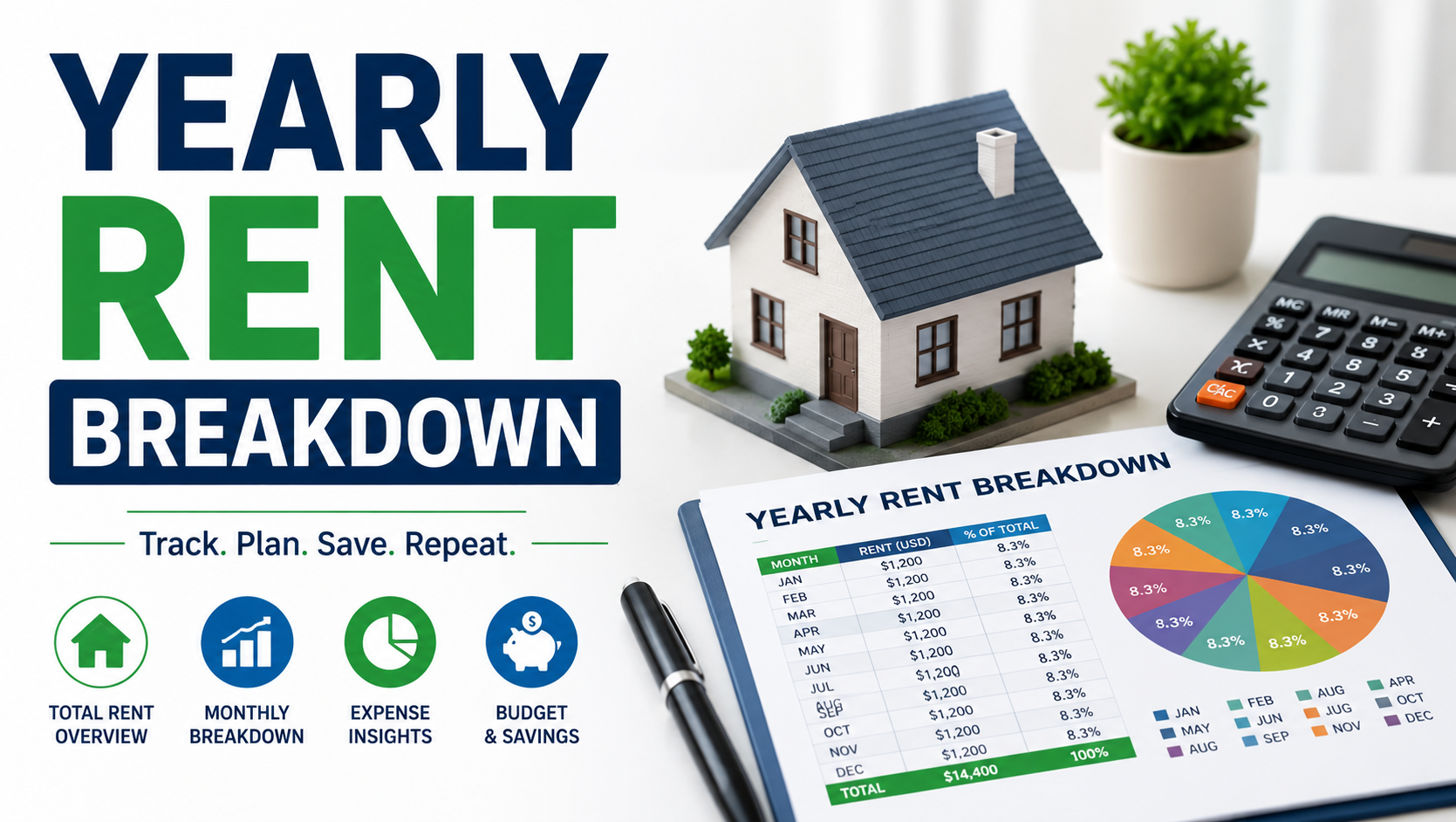
Yearly Rent Breakdown: Most renters know their weekly rent figure off the top of their head. Far fewer could tell you, without pausing to do the maths, what that same rent actually costs them across a full year. And that gap matters more than it seems, because the yearly number is the one that actually shapes your financial life , it’s what competes with your savings goals, your travel plans, your ability to handle an unexpected expense, and eventually, whether renting versus buying makes sense for you.
This article steps back from the weekly-versus-monthly conversion question and looks at rent the way an accountant or financial planner would: as an annual cost. Once you see the full-year number clearly, a lot of decisions that felt fuzzy , like whether to renew a lease, negotiate rent, or look elsewhere , tend to get a lot easier.
Visit Now: https://rentcalculatorpro.com/
Why the Yearly Figure Tells a Different Story(Yearly Rent Breakdown)?
When rent is advertised at $520 a week, it doesn’t feel like a big number. It’s the kind of figure you can mentally round off without much discomfort. But stretch that same $520 across a full year and you get $27,133.60.(Yearly Rent Breakdown) Suddenly it’s a number that sits next to your annual income, your annual savings target, or the cost of a car , and it forces a different kind of conversation with yourself.
This is partly a psychological effect that behavioural economists call “framing.” Smaller, recurring numbers feel less significant than the same amount expressed as one lump figure, even though they’re mathematically identical. (Yearly Rent Breakdown)Rent is almost always advertised in the smaller-feeling weekly format for exactly this reason , it’s not dishonest, it’s just how the market has always done it, but it does mean renters rarely confront the real annual scale of their biggest expense unless they calculate it themselves.
How to Calculate Your True Yearly Rent?
The formula is simple, but it’s easy to get wrong if you take a shortcut. Multiplying your weekly rent by 52 feels intuitive, but it slightly undercounts the year.
Yearly Rent = Weekly Rent × 52.18
The 0.18 exists because a calendar year doesn’t divide evenly into whole weeks , there are 365.25 days in an average year (accounting for leap years), which works out to about 52.18 weeks rather than a clean 52. (Yearly Rent Breakdown)Over a single year the difference is small. Over a decade of renting, it adds up to real money that a rough estimate would have missed.
If you’re working from a monthly figure instead, the formula is just as straightforward:
Yearly Rent = Monthly Rent × 12
This one’s accurate because months already divide cleanly into a year , there’s no rounding error to worry about, which is one advantage of monthly-based budgeting over weekly.
A worked example: let’s say your rent is $600 a week. (Yearly Rent Breakdown)Multiply that by 52.18 and you get a true yearly rent of $31,308. Compare that to the rough shortcut of $600 × 52, which gives $31,200. That’s a $108 difference , not huge on its own, but it’s the kind of gap that, when it shows up across every calculation in your budget, quietly throws off your annual planning by a few hundred dollars without you noticing why.
If you’d rather not do this by hand every time your rent changes, our Rent Calculator handles the conversion instantly and uses the accurate 52.18-week basis automatically.
Read More: A Complete Guide to Calculating Rent in Australia (2026)
What Your Yearly Rent Actually Competes With?
Once you have your real annual rent figure, it’s worth holding it up against the other things that number could be doing for you. This isn’t about guilt , it’s about making an informed trade-off rather than an accidental one.
A renter paying $31,308 a year is also looking at a figure that, over five years, totals more than $156,000. (Yearly Rent Breakdown)That’s a meaningful house deposit in many parts of the country, a fully funded emergency buffer many times over, or years of accelerated debt repayment. (Yearly Rent Breakdown)None of this means renting is the wrong choice , for many people, especially those who value flexibility, live in expensive property markets, or aren’t ready to buy, renting remains the more sensible option. But seeing the number clearly lets you decide that on purpose, rather than just absorbing the cost without ever totalling it up.
How Yearly Rent Compares to Income?
A useful sanity check is calculating what percentage of your gross annual income goes toward rent. Using the commonly cited 30% guideline: on a $70,000 salary, 30% works out to $21,000 a year, or about $402 a week. (Yearly Rent Breakdown) On a $90,000 salary, 30% works out to $27,000 a year, or about $517 a week. And on a $110,000 salary, 30% works out to $33,000 a year, or about $632 a week.
If your real yearly rent, calculated properly using 52.18 weeks, sits meaningfully above these figures, it doesn’t automatically mean you’re in trouble , plenty of people in high-rent cities like Sydney or Melbourne sit well above 30% and manage fine by adjusting other parts of their budget. (Yearly Rent Breakdown) But it’s a useful flag to revisit your overall spending plan, rather than something to ignore.
The Hidden Costs That Inflate Your Real Yearly Total
The advertised rent is rarely the full annual cost of staying housed. (Yearly Rent Breakdown) A more honest yearly figure usually includes a few extras that are easy to overlook when you’re only thinking in weekly terms.
Bond is usually a one-off cost, typically four weeks’ rent, refunded at the end of the tenancy if the property is left in good condition. (Yearly Rent Breakdown) It’s still cash you need to have available in year one, and it’s worth including in your first-year total even though it isn’t a true ongoing expense.
Utilities such as electricity, gas, and water usage charges can easily add $1,500–$3,000 a year depending on household size, climate, and usage habits. (Yearly Rent Breakdown)These aren’t part of “rent” technically, but they’re part of your true cost of housing.
Contents insurance for a rented property typically runs $200–$500 a year, and is worth factoring into your full housing cost even though it’s optional.
And if your rent goes up partway through the year, which is common on periodic leases, your true annual figure for that calendar year is actually a blend of the old and new rates, not a clean multiplication of either one.
Add these together and a $31,000-a-year rent figure can realistically represent a $34,000–$36,000 total annual housing cost once everything is included.(Yearly Rent Breakdown) That’s the number that actually matters for budgeting purposes.
Why Tracking Yearly Rent Helps With Lease Renewals?
One of the most practical reasons to know your real yearly rent is lease renewal time. When a landlord proposes a rent increase , say, from $580 to $610 a week , it’s easy to mentally shrug off a $30-a-week jump as small. (Yearly Rent Breakdown) But translated to the yearly figure, that’s an extra $1,565 a year, which is a much more concrete number to weigh against your actual pay rises, cost-of-living increases, or the rental market in your area.
Knowing the yearly impact of a proposed increase also puts you in a stronger negotiating position. (Yearly Rent Breakdown) If you can calmly point out that a requested increase represents a jump well above wage growth or comparable properties nearby, you’re negotiating from data rather than just a gut feeling that the new figure “feels like a lot.”
Read More: RENT CALCULATOR: HOW TO FIND AFFORDABLE RENT BASED ON YOUR INCOME
Using Yearly Rent to Decide Between Properties
When comparing two rental listings, weekly figures can make small differences look more trivial than they are. A $20-a-week gap between two properties sounds minor , but annualised, that’s $1,043.60 a year, which might be enough to cover a holiday, a chunk of your annual insurance, or several months of an emergency fund top-up(Yearly Rent Breakdown).
This is exactly why it’s worth running every property you’re seriously considering through a proper yearly calculation before making a decision, rather than comparing the weekly headline figures side by side. (Yearly Rent Breakdown)The yearly view tends to reveal which “minor” differences are actually worth caring about.
A Quick Reference for Your Own Numbers
If you want to work out your own true yearly rent right now, here’s the simple version: take your current weekly rent, multiply it by 52.18 (not 52), and that’s your accurate yearly rent figure.(Yearly Rent Breakdown) From there, add an estimate for utilities, insurance, and any other regular housing costs, then compare the total against your gross annual income to see what percentage of your earnings it represents.
This process takes a couple of minutes but gives you a far more honest picture than thinking about rent purely in weekly terms.
Final Thoughts
Weekly rent figures are designed to feel manageable, and in fairness, they usually need to be , most people are paid on a weekly or fortnightly cycle, so it makes sense to think about rent that way day to day. (Yearly Rent Breakdown) But the yearly figure is the one that reveals what your housing costs are actually doing to your finances over time. (Yearly Rent Breakdown)It’s the number that should inform decisions about lease renewals, comparing properties, negotiating increases, and deciding when renting versus other housing options makes the most sense for your situation.
Take two minutes this week to calculate your true yearly rent properly, using 52.18 weeks rather than a rough estimate, and add in your typical utility and insurance costs. It’s a small exercise that tends to clarify a surprising amount about your overall financial picture.
FAQ’s
1. Why does my yearly rent feel higher than I expected when I calculate it properly?
Most people mentally estimate yearly rent by multiplying the weekly figure by 50 or 52, which already undercounts the real total. (Yearly Rent Breakdown) Once you use the accurate 52.18-week basis, the number naturally comes out a bit higher than the rough mental maths most people default to.
2. Should I include bond in my yearly rent total?
It’s reasonable to include it in your first year’s total cash outflow, since it’s money you need to have ready, but it isn’t a true ongoing yearly expense since it’s refundable. (Yearly Rent Breakdown)Many renters track it separately as a one-off moving cost rather than folding it into the recurring yearly rent figure.
3. How do I calculate yearly rent if my landlord increases rent partway through the year?
Calculate it in two parts: the number of weeks at the old rate multiplied by that rate, plus the number of weeks at the new rate multiplied by the new rate, then add the two together. (Yearly Rent Breakdown) This gives a blended yearly figure rather than an inaccurate single-rate estimate.
4. Is yearly rent calculated differently for a 6-month lease versus a 12-month lease?
The weekly-to-yearly formula stays the same regardless of lease length. (Yearly Rent Breakdown) For a 6-month lease, you’d typically calculate the cost for that actual period rather than projecting a full year, since you don’t yet know what the renewal terms will look like.
5. How much does a small weekly rent difference actually add up to over a year?
More than most people expect. A $15-a-week difference adds up to roughly $782.70 a year using the accurate 52.18-week multiplier, which is often enough to make a “minor” gap between two listings worth reconsidering.
6. Does annual rent include things like body corporate or strata fees?
No, those are typically the landlord’s responsibility, not the tenant’s, unless your lease specifically states otherwise.(Yearly Rent Breakdown) It’s worth confirming this in writing before assuming your rent is the only annual housing cost you’ll face.
7. How do I estimate my yearly rent if I’m only just starting to look for a rental?
Take the weekly rent of properties you’re seriously considering and multiply by 52.18 to get a realistic annual figure for each, rather than comparing the weekly headline numbers. (Yearly Rent Breakdown)This gives you an apples-to-apples yearly view before you’ve even applied.
8. Why do some lease agreements quote an annual figure instead of weekly?
This is more common in certain commercial leases and some long-term residential agreements, where landlords prefer to express the total commitment as one annual sum rather than a recurring weekly amount. The underlying maths is the same either way.
9. How do I figure out what percentage pay rise I’d need to offset a rent increase?
Divide the yearly increase in rent by your current gross annual income. For example, a $1,000-a-year rent increase on a $75,000 salary represents about a 1.3% income offset needed just to stay at the same affordability level.
10. Does yearly rent calculation change for a granny flat, studio, or shared house?
No, the weekly-to-yearly conversion formula is identical regardless of property type. What changes is the base rent figure itself, not the method used to annualise it.
11. How can I use my yearly rent figure to plan for next year’s budget?
Treat your current yearly rent as a baseline, then add a buffer of 3–7% to account for a likely rent increase at renewal, based on typical annual increases in many Australian markets. This gives you a more realistic forecast than assuming rent will stay flat.
12. Is it normal for yearly rent to exceed $30,000 in Australian cities?
In many metro areas, yes — particularly Sydney, Melbourne, and parts of Brisbane and Perth, where weekly rents well above $550–$600 are common for standard one and two-bedroom properties. Whether that’s “normal” for your situation depends more on your income and local market than on a fixed benchmark.
13. How do I calculate my effective yearly rent if I received a rent-free period?
Subtract the value of the free weeks from your total yearly cost, then express the result as your effective annual rent. For example, two free weeks on a $600-a-week lease effectively reduces your true yearly cost by $1,200 from the full $31,308 figure.
14. Should yearly rent calculations factor in expected interest rate changes?
Not directly, since rent isn’t tied to interest rates the way a mortgage is. However, interest rate movements often influence landlords’ decisions on rent increases over time, so they can indirectly affect your yearly figure at renewal.
15. How do I compare my yearly rent to the cost of buying a similar property?
Compare your true annual rent (using the 52.18-week calculation) against the estimated annual cost of a mortgage on a similar property, including interest, rates, insurance, and maintenance — not just the loan repayment alone. This gives a fairer like-for-like comparison than rent versus mortgage repayment alone.
16. Does paying rent annually upfront instead of weekly save money?
Some landlords offer a discount for upfront annual payment, but this isn’t standard practice across Australia and depends entirely on what’s negotiated directly with the landlord or agent. It’s worth asking, but don’t assume it’s available by default.
17. How accurate do I need to be when estimating utilities as part of my yearly housing cost?
A rough estimate based on your previous bills, or a similar-sized household’s average usage, is usually sufficient for budgeting purposes. The goal is to avoid underestimating significantly, not to predict the exact dollar figure months in advance.
18. What’s the simplest way to track my yearly rent changes over multiple years?
Keep a simple running note each time your rent is reviewed, listing the date, the new weekly rate, and the recalculated yearly figure. Over a few years, this gives you a clear personal record of how your housing costs have actually moved, rather than relying on memory.