
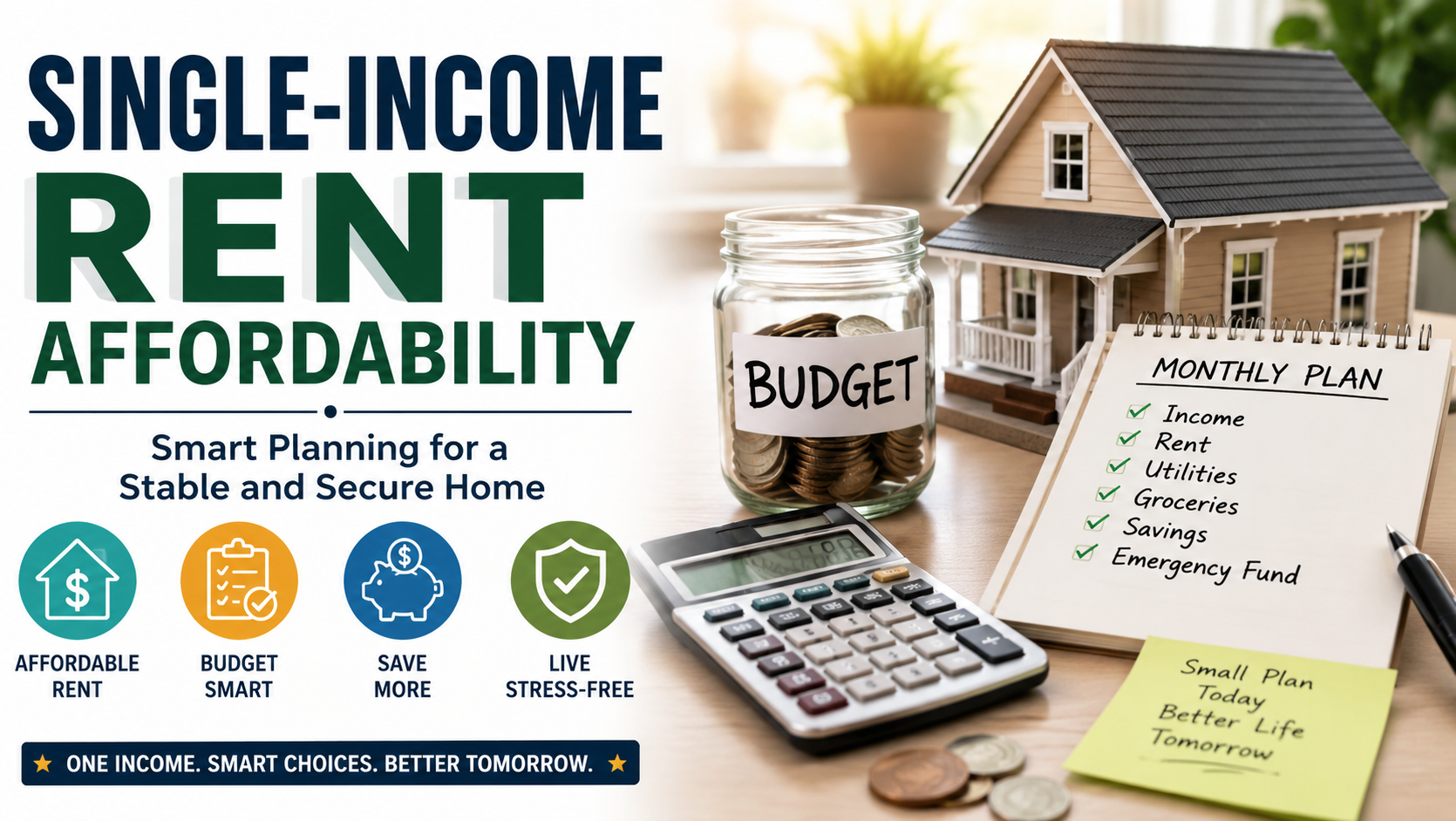
Try this sometime: sit down with your rent notice in one hand and your bank balance app open in the other. Do the math out loud. If you’re a single-income earner, you already know that feeling , that small pause before you hit “pay,” where you quietly hope nothing else comes up this month.(Single-Income Rent Affordability)
Rent doesn’t ask how many people are earning in your house. It shows up on the same date, wants the same amount, whether there’s one salary behind it or two. And for single-income households , a single parent, someone living solo and building a career, a retiree managing alone, or a couple who’s chosen to get by on one income , that’s exactly the problem. The math was never really built for you.
This isn’t some rare, unusual situation either. Walk into any apartment building in a big city and you’ll find plenty of people quietly carrying this weight. The struggle is real, and it’s not really about bad money habits. It’s about a system that assumes something that isn’t true for a huge number of renters.
Visit now:https://rentcalculatorpro.com/
Why It Hits Differently When There’s Just One Income(Single-Income Rent Affordability)
We’ve all heard the “30% rule” , don’t spend more than 30% of your income on rent. Sounds simple enough. Except that rule was written with an “average” household in mind, and averages have a funny way of hiding the people who don’t fit neatly into them.
When two incomes are splitting one rent bill, hitting 30% is a lot more realistic , there’s simply more money in the pot. A single earner doesn’t get that cushion. The exact same apartment that eats up 22% of a couple’s combined salary might quietly swallow 38% or more of one person’s paycheck. Nothing about the apartment changed. Just who’s paying for it.
And here’s the part that rarely gets talked about , rent is priced by the unit, not by how many people live in it. A landlord doesn’t care if it’s one person or three splitting the cost. So in a strange way, a single-income household ends up paying a kind of invisible premium just for being… one household, one income.
Then there’s the safety net problem. Two-income homes have a backup if one job disappears or hours get cut. Single earners don’t. There’s no “well, my partner’s paycheck will cover us this month.” That missing cushion changes how rent feels , every payment carries a little extra “what if” tucked inside it.
Let’s Talk Numbers for a Second(Single-Income Rent Affordability)
Picture a single earner making a decent, realistic salary in a mid-sized city. After taxes take their cut , often 15 to 25% gone before it even hits the bank , what’s left has to stretch. And rent alone frequently eats up 35 to 45% of that remaining amount. That’s before groceries, before a phone bill, before a single doctor’s visit(Single-Income Rent Affordability).
What’s left over for everything else is thin. Really thin. And that’s the honest truth nobody says out loud enough: it’s not that single-income earners are careless with money. It’s that there was never enough room built into the system for one income to cover costs that were quietly priced with two incomes in mind.
That’s exactly why so many people living alone or supporting a household solo feel stuck in a paycheck-to-paycheck loop , even with a stable job, even without reckless spending. Rent just takes up the space where savings should be growing.(Single-Income Rent Affordability)
The Part Nobody Puts in Spreadsheets
Affordability isn’t only a numbers problem. It’s an emotional one too, and honestly, that side gets ignored way too often.
There’s a specific kind of quiet stress that comes with being the only person holding up the household financially. A rent increase notice doesn’t just feel like a bill , it feels personal. And every surprise expense , a car that won’t start, a dentist appointment, a day of missed work because you’re sick , turns into a small crisis of “do I pay rent, or do I deal with this right now?”(Single-Income Rent Affordability)
Single parents feel this in a particularly heavy way. It’s never just about a roof over their own head. It’s tied to which school their kid goes to, how safe the neighborhood is, how close they are to family who can help with childcare. Moving somewhere cheaper isn’t a simple financial decision when it means pulling a child out of their school or losing the people nearby who actually help.
For people living alone , whether early in their career or later in life as a retiree , the weight looks different but is just as real. It’s watching friends split rent with a partner and realizing that’s simply not an option for you right now(Single-Income Rent Affordability). It’s a quiet feeling of being financially “behind,” even while working just as hard, sometimes harder, than people in two-income homes.
None of this shows up on an affordability calculator. But it shapes real choices , where people end up living, how long they stay stuck in jobs they’ve outgrown just because stability matters more than growth, how much quiet stress just sits in the background of everyday life.
Okay, So What Actually Helps?(Single-Income Rent Affordability)
There’s no magic fix for a structural problem like this. But there are real, honest things that make a difference(Single-Income Rent Affordability).
Stop treating 30% like a strict law. For a single income, especially in an expensive city, 35–40% might just be the honest reality , and that’s okay. Beating yourself up over a number that was never realistic for your situation to begin with just adds guilt on top of an already hard situation.
Think about location as a choice, not a compromise. A slightly longer commute, or a neighborhood a notch less trendy, can free up real money , sometimes 10-15% of your income. That’s not “settling.” That’s making an intentional trade instead of paying extra for convenience without even realizing it(Single-Income Rent Affordability).
Let go of the stigma around sharing space. Co-living and roommate arrangements have changed a lot. They’re not a step backward anymore , for a lot of financially smart single earners, it’s a deliberate strategy, not a compromise.
Ask for a better deal. Actually ask. Landlords are often more flexible than people assume, especially when the market softens a bit. Offering a longer lease for a lower rate, or just directly asking for a discount, works more often than people expect. Worst case, they say no , and you’re exactly where you started(Single-Income Rent Affordability).
Budget off what actually lands in your account. Not your gross salary , your real take-home pay, after taxes and deductions. It’s a more honest number, and honestly, a kinder one to plan around.
Even a small buffer changes everything. One month’s rent saved up as a cushion doesn’t erase the risk of a single income , but it changes how it feels to carry that risk. That little bit of breathing room matters more than people expect(Single-Income Rent Affordability).
Don’t be too proud to look into rental assistance. These programs exist because this exact gap , one income trying to cover rent priced for households with more than one , is recognized as a real, common problem. Using that support isn’t a failure. It’s just being smart about a system that wasn’t built evenly to begin with.
read more:Monthly Rent Budgeting Tips for Australian Families(Monthly Rent Budget Australia)
The Bigger Picture(Single-Income Rent Affordability)
Beyond personal budgeting, there’s a real conversation worth having about how rental markets are built in the first place. Pricing a unit purely by size and location, with zero regard for how many incomes are behind the rent, quietly punishes exactly the people who can least afford it , single parents, retirees living alone, people rebuilding their lives after a divorce or job loss.(Single-Income Rent Affordability)
Some cities are starting to push back , more studio and one-bedroom units (which are usually in short supply relative to demand), income-based rental assistance, clearer conversations about what “affordable” actually means for a single earner versus a two-income family. These are slow, policy-level fixes. But they matter, because no amount of personal budgeting can fully undo a market that wasn’t built with single-income renters in mind.
Conclusion
If you’re a single-income earner and rent still feels like it’s squeezing the air out of your budget every month , that’s not a reflection of you doing something wrong. It’s a reflection of a system that quietly assumed two incomes as the default, and never really adjusted for the people who don’t fit that assumption.Rent will keep showing up, same date, same amount, no matter what. But how you plan around it , realistic expectations, smart trade-offs, a little cushion for the unexpected , can turn something that feels crushing into something that’s just… manageable. One paycheck, doing the work of two, one month at a time(Single-Income Rent Affordability).
FAQ,s
1. What percentage of income should a single-income household spend on rent?
The classic advice is 30%, but honestly, for a single earner in a pricier city, 35-40% is often the realistic range(Single-Income Rent Affordability). What matters more than hitting an exact number is making sure you can still cover essentials and put something aside, even if it’s small.
2. Why does the 30% rule feel impossible for single earners?
Because it was designed around an “average” household , usually assumed to have more than one income. When there’s just one paycheck covering the same rent a couple might split(Single-Income Rent Affordability), the percentage naturally climbs higher, even though nothing about the apartment changed.
3. Should I calculate rent affordability based on gross or net income?
Net income , what actually lands in your bank account after taxes. Gross income numbers look better on paper but don’t reflect what you really have to work with month to month.
4. Is it a bad idea to live alone on a single income?
Not at all , it just means being more intentional. Living alone is completely doable; it just requires being honest about trade-offs(Single-Income Rent Affordability), like location, apartment size, or building a slightly bigger savings cushion than a dual-income household might need.
5. How can a single-income household build an emergency fund while rent is already tight?
Start small. Even setting aside a fixed, modest amount every month , even $50 or $100 , adds up. The goal isn’t perfection; it’s having something to fall back on so one bad month doesn’t turn into a crisis.
6. Is co-living or having a roommate a smart option for single earners?
Yes, and there’s really no shame in it anymore. Splitting rent through a roommate or a co-living space can free up a significant chunk of income(Single-Income Rent Affordability), and modern shared housing options often still offer privacy and comfort.
7. Can I actually negotiate rent as a single tenant?
Often, yes. Landlords may be more flexible than you’d think, especially in a softer market. Offering a longer lease in exchange for a lower monthly rate, or simply asking directly, sometimes works better than people expect(Single-Income Rent Affordability).
8. What if my rent already takes up more than 40% of my income?
That’s a sign it’s time to reassess , either by looking at slightly cheaper areas, considering a shared living situation, or checking if you qualify for local rental assistance programs. It doesn’t mean you’re failing; it means the current setup isn’t sustainable long-term(Single-Income Rent Affordability).
9. Are single parents affected differently by rent affordability issues?
Yes, significantly. For single parents, rent isn’t just about their own comfort , it’s tied to school access, neighborhood safety, and proximity to family support. That makes moving to cheaper housing a much bigger decision than just dollars and cents.
10. Do rental assistance programs actually help single-income households?
They can, and they exist specifically because this affordability gap is recognized as a real, structural issue , not a personal failure. It’s worth checking what’s available locally rather than assuming you won’t qualify.
11. How does location affect affordability for single earners?
A lot. Moving slightly further from a city center, or choosing a less “trendy” neighborhood, can meaningfully lower rent , sometimes by 10-15% of income(Single-Income Rent Affordability). It’s a trade-off worth considering deliberately, rather than paying extra for convenience without noticing.
12. Is it normal to feel anxious about rent as a single-income earner?
Completely normal. Without a second income as a backup, every unexpected expense feels heavier, and that stress is real , it’s not just “bad budgeting.” Recognizing that emotional weight is part of managing it well.
13. Should single-income households avoid saving altogether if rent is high?
No , even a small, consistent saving habit matters more than a large, inconsistent one. Building even a one-month rent buffer changes how manageable the situation feels, even if it takes time to get there.
14. Are studio or one-bedroom apartments more affordable for single incomes?
Usually, yes , but they’re also often in short supply relative to demand, which can push prices up. It’s worth comparing several options and not assuming the smallest unit is automatically the cheapest per square foot.
15. What’s the most important mindset shift for single-income renters?
Letting go of the idea that struggling with rent means doing something wrong(Single-Income Rent Affordability). The system wasn’t built evenly for single incomes , recognizing that helps take away unnecessary guilt and makes room for smarter, more realistic planning.