
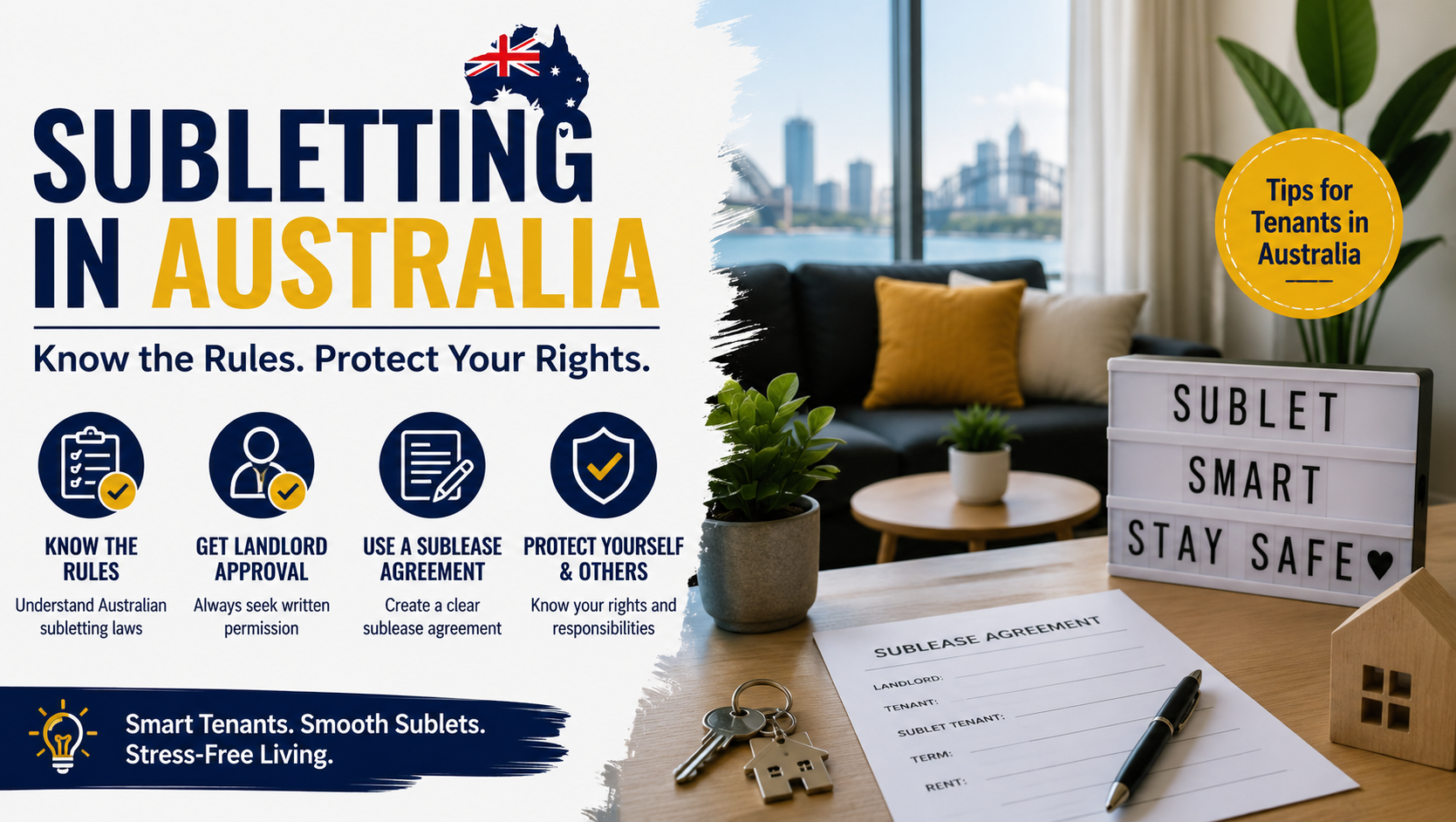
You signed a twelve-month lease back when everything felt fine. Now things have changed. Maybe there’s a new job in another city. Maybe a relationship shifted and suddenly you’ve got a spare room Subletting in Australia. Maybe you’re just sitting there looking at rent that doesn’t match how much space you’re actually using anymore. So you start thinking about subletting in Australia.
On paper it sounds easy. Someone else moves in, someone else hands you cash or a bank transfer each week, and your rent problem quietly disappears. In reality, subletting in Australia is one of those topics everyone has a half-formed opinion about and almost nobody actually understands properly. Is subletting in Australia even legal? Do you need permission first? What actually happens if your landlord finds out after the fact?
This guide goes through subletting in Australia properly , legally, financially, practically , so you’re not guessing your way through something that could genuinely mess up your tenancy if you get it wrong.
Visit now: https://rentcalculatorpro.com/
What Subletting Actually Means
Let’s get the definition of subletting in Australia straight first, because people throw this word around loosely and that’s honestly where most of the confusion starts.
Subletting in Australia happens when a tenant who already holds a lease rents out all or part of that property to someone else , a subtenant , while staying legally responsible for the original lease themselves. Your name’s still on the paperwork Subletting in Australia. You’re still the one the landlord chases if rent doesn’t land on time. The subtenant pays you, not the agent, and if the toilet breaks at 11pm, you’re the one fielding that call, not them.
That’s different from lease assignment, where the whole lease gets transferred and you walk away completely. It’s also different from just adding a housemate through the normal, approved channel. Subletting sits in its own little category, and mixing it up with these other arrangements is exactly where a lot of renters trip themselves up.
People sublet for all sorts of reasons, and subletting in Australia comes up more often than you’d think. Travelling for a few months and not wanting to break the lease. A housemate bailing and leaving a gap that needs filling fast. A property that isn’t being used every day. Whatever the reason, subletting in Australia always comes back to one question that decides everything else: does your landlord actually know, and have they said yes in writing?
Is Subletting in Australia Actually Legal?
Short answer , subletting in Australia is legal, but only under certain conditions, and those conditions depend a lot on your lease and which state you’re in.
Nearly every standard residential lease in this country has a clause about subletting tucked somewhere in the fine print. In most cases it says you can’t sublet without written consent from the landlord or their agent. This isn’t just some throwaway line either , it’s built into tenancy law across the country, and ignoring it puts your whole tenancy at risk, not just the sublet arrangement.
So doing it without asking isn’t a criminal offence, but it’s very likely a breach of your lease. And a breach can lead to a termination notice, and in worse cases, eviction proceedings or financial penalties if the landlord ends up out of pocket because of it.
Here’s the flip side though , ask first, get it in writing, and subletting in Australia becomes a completely normal, protected arrangement. Plenty of landlords are actually fine with it once they know who’s living there and that it won’t create extra risk for them. The issue is almost never the subletting itself. It’s doing it quietly and hoping nobody ever notices.
Why Landlords Take This So Seriously
It’s tempting to write off the permission requirement around subletting in Australia as pointless red tape, but there are real reasons landlords care about subletting in Australia as much as they do.
Insurance is the big one. Most landlord insurance policies are written around a specific, disclosed list of occupants. If an undisclosed subtenant damages something or gets hurt on the property, that policy might not actually cover it, and the landlord’s left holding the bill.
Then there’s liability more broadly. If a dispute breaks out, or something gets damaged, or bills go unpaid, the landlord wants a clean paper trail showing exactly who’s legally allowed to be there Subletting in Australia. Unapproved subletting muddies that trail badly.
And control matters too. Landlords screen tenants for a reason , credit checks, references, rental history , all of that gets skipped the second an unapproved subtenant just moves in. From where the landlord sits, unauthorised subletting in Australia basically means a total stranger is living in their property with zero vetting done.
None of this means every landlord is going to say no automatically. Plenty are reasonable about it, especially if you communicate well. But it explains why the consent rule exists, and why skipping it is a genuine risk rather than some minor technicality nobody actually enforces.
How the Rules Differ State by State
Tenancy law in Australia is handled at the state and territory level, so the fine print on subletting in Australia shifts a bit depending on where the property actually sits. Whichever state you’re in, subletting in Australia still needs proper consent. The core principle , get written consent , stays the same everywhere. The details don’t.
New South Wales , under the Residential Tenancies Act, you need written consent before Subletting in Australia, and a landlord can’t unreasonably refuse a reasonable request. If they do refuse without good cause, you can take it to NCAT for a ruling.
Victoria , similar setup. Consent is required, refusal can’t be unreasonable, and disputes go to VCAT if things get sticky.
Queensland , written approval needed before subletting any part of the place, and any refusal generally needs a legitimate reason behind it, not just a gut “no.”
Western Australia, South Australia, Tasmania, the ACT, and the Northern Territory , each has its own tenancy legislation, but they all follow roughly the same shape. Consent required, unreasonable refusal challengeable through the local tribunal.
The practical takeaway everywhere is basically identical: subletting in Australia runs on a consent-based system, and “reasonable” is doing a lot of the heavy lifting, both in what you’re allowed to ask for and what a landlord’s allowed to refuse. If you’re actually planning to sublet, spend the ten minutes checking your state’s residential tenancies authority website, because these details do get tweaked from time to time.
Doing It Properly, Step by Step
If you’ve decided subletting in Australia is genuinely the right move for you, doing it the proper way protects you far more than it protects anyone else in the arrangement.
First, read your actual lease. Before you say a word to your landlord, check the subletting clause in your contract Subletting in Australia , some leases spell out an exact process, including notice periods or paperwork you need to provide.
Second, put the request in writing. A verbal “yeah that should be fine” is worth almost nothing if things go wrong later. Email your landlord or agent. Explain who you want to sublet to, for how long, and why.
Third, give them some basic info about the subtenant. Landlords approve subletting far more readily when they know roughly who’s moving in , not a full background check, just enough to feel comfortable.
Fourth, wait for actual written approval before anyone moves a single box in. Text messages count. Emails count. A signed lease addendum is even better. A verbal shrug does not count.
Fifth, write up a simple agreement between yourself and the subtenant. Rent amount, payment dates, bond, who’s responsible for what. It won’t override your head lease, but it protects both of you and makes expectations clear from day one.
Sixth , and people forget this one constantly , keep paying your original landlord yourself. You’re still the tenant of record. The subtenant pays you, and you keep meeting your obligations under the original lease exactly as before.
Follow that process and subletting in Australia stops being a risky grey area and becomes something documented, defensible, and honestly pretty low-stress.
Read more: How to Build a Realistic Monthly Rent Budget in Australia (2026)
The Money Side of Subletting
This is where a rent calculator earns its keep when you’re working out the financial side of subletting in Australia, and it’s also where people quietly get the numbers wrong without realising.
If you’re subletting the whole place, your existing rent is usually the fair starting point , split proportionally for a partial sublet, or matched directly for a whole-property arrangement over a set period. If it’s just a room while you keep living there, things get a bit more nuanced. You’d typically want to factor in room size, private bathroom access, and a share of the bills.
A weekly-to-monthly converter helps line things up cleanly, especially if your subtenant thinks in a different pay cycle than your lease does. Australian listings are almost always quoted weekly, but plenty of people budget monthly in their head, so converting between the two saves an awkward conversation before any money’s even changed hands.
Bond is worth thinking about too. People forget this constantly , a subtenant arrangement should generally include some kind of security deposit held by the head tenant, mirroring the protection a landlord gets through the official bond. Subletting in Australia without any bond protection on your end leaves you exposed if the subtenant damages something or walks away owing money.
An affordability check cuts both ways here as well. Just like a landlord checks whether a tenant can actually manage the rent, it makes sense for you to sanity-check whether your prospective subtenant’s income comfortably covers what you’re asking for. A rough rule a lot of people use is keeping housing costs under roughly 30 percent of gross income , and that guide works just as well when you’re the one collecting the rent rather than paying it to a landlord.
Subletting vs Assignment , Not the Same Thing
People mix these two up constantly, and it’s an easy mistake to make, but they’re legally different animals.
With subletting in Australia, you stay the tenant the whole way through. Your name stays on the lease, your obligations don’t move anywhere, and the subtenant’s relationship is with you , not the landlord.
With assignment, the whole lease transfers over. You exit completely, and the new person becomes directly responsible to the landlord instead of you. Assignment also needs landlord consent in almost every state, but the actual legal outcome is quite different from a sublet.
If you’re leaving a property for good and handing it off to someone long-term, assignment is usually the cleaner path. Subletting makes more sense when you plan on coming back, or when the arrangement is only ever meant to be temporary or partial.
What Happens If You Just… Don’t Ask
This is the part people skip past, right up until it becomes their problem.
Unauthorised subletting in Australia is generally treated as a breach of your tenancy agreement. Depending on the state and how serious the breach is, you could be looking at a formal notice to remedy it, termination of the tenancy, or , in worse cases , an application to a tribunal for possession of the property.
There’s a money angle too. If the landlord’s insurance doesn’t cover an incident because there was an undisclosed occupant, and something actually goes wrong , a fire, a break-in, damage caused by the subtenant , the original tenant can end up personally on the hook for costs that would’ve otherwise been covered.
And beyond the legal side, there’s just trust. Once a landlord finds out about unauthorised subletting, even well after the fact, it tends to sour the relationship for the rest of the tenancy. Every future request , repairs, lease renewal, a bit of flexibility , gets harder to get approved. Rarely worth the short-term convenience, honestly.
A Few Real-World Scenarios
Sometimes it helps to see how this plays out in practice, because subletting rarely happens out of nowhere , it’s usually triggered by something specific going on in someone’s life.
The overseas trip. Six weeks travelling booked, and paying full rent on an empty apartment the whole time feels wasteful. This is probably the single most common reason people look into subletting in Australia, and it’s also one of the easier cases to get approved, since the timeframe is short and clearly defined.
The mid-lease job move. Your company transfers you interstate three months before the lease is up. Rather than breaking it and copping a penalty, having someone take over temporarily can work out cheaper for everyone involved , assuming the landlord’s on board.
The empty room after someone moves out. A housemate leaves without much warning, and instead of covering their share solo or going through the slower formal tenant-addition process, a short-term subtenant fills the gap while you figure out a longer-term plan.
The student on exchange. Uni students heading overseas for a semester often look at subletting their room to another student, since the timing lines up neatly with a semester and there’s usually less money at stake than with a whole apartment.
None of these situations require doing anything shady, and subletting in Australia works fine for all of them when it’s handled right. What separates the smooth outcomes from the messy ones is basically always whether the proper consent process got followed from the start.
Getting the Paperwork Right
This is the part people underestimate the most. It doesn’t need to be some formal contract drawn up by a solicitor, but it does need to actually cover the basics.
A simple sublet agreement between you and your subtenant should spell out the rent amount and how often it’s due, the start and end dates, what’s included (utilities, internet, parking, whatever applies), any bond or security amount held, and basic house rules if you’re sharing the space. Put it in writing , even a clearly worded email both of you reply to and confirm is enough. This isn’t about not trusting the person. It’s about making sure nobody’s relying on memory once a disagreement actually shows up, because sooner or later, something usually does.
Hang onto a copy of your landlord’s written consent alongside that agreement too. If a dispute ever ends up in front of a tribunal, having a clear trail showing the arrangement was approved, documented, and handled properly puts you in a much stronger spot than trying to explain a vague verbal understanding after the fact.
A Few Practical Tips
Always get consent in writing for subletting in Australia, even if your landlord seems totally relaxed about it in conversation. Screen your subtenant reasonably , even just a proper conversation about expectations goes a long way, let alone an actual reference check. Set clear rules early around bills, cleaning, guests, and noise, especially if you’re sharing the space rather than handing over the whole property. Keep a record of every rent payment, ideally through a bank transfer rather than cash, so there’s never any argument later about what got paid and when.
It’s also worth revisiting the numbers every so often. Rent conditions shift, bills change, and a split that felt fair six months ago might not reflect reality anymore. Running the figures again through a simple rent calculator every few months keeps things fair on both sides and stops small financial mismatches from turning into resentment.
And don’t treat silence as approval. If you’ve asked your landlord about subletting and haven’t heard back, follow up before letting anyone move in. An unanswered email isn’t a yes, and assuming otherwise is exactly the kind of shortcut that leads to disputes down the track.
Read more: Rental Bond in Australia: The Complete Guide Nobody Really Explains Properly
Final Thoughts
Subletting in Australia isn’t actually that complicated once you get the core rule: ask first, get it in writing, and treat the whole arrangement with the same seriousness as any other tenancy. The tenants who run into real trouble are almost always the ones who skipped the consent step, not the ones who bothered doing it properly.
If you’re weighing up whether subletting makes sense for your situation, run your numbers through a proper rent calculator before committing to anything. It’s one of the simplest ways to avoid an awkward conversation later. Get the numbers right, get the paperwork right, and subletting in Australia can actually solve a real problem instead of quietly creating a new one.
FAQ,s
Do I always need my landlord’s permission to sublet?
Pretty much, yes. Across every state and territory, subletting in Australia generally requires written consent from the landlord or agent, and skipping that step is typically a breach of your lease.
Can my landlord just refuse for no reason?
Not really. Most tenancy laws say consent can’t be unreasonably withheld. If you think a refusal is unreasonable, you can usually take it to your state’s tenancy tribunal.
Isn’t subletting basically the same as a share house?
Not quite. A share house usually has everyone on the lease from the start, or properly added later through the right channel. Subletting specifically involves renting out space to someone who isn’t on the original lease at all.
What happens to the bond if I sublet part of the place?
The official bond stays tied to the head lease and the original tenant. Any bond-style arrangement between you and a subtenant is separate, and it’s on you two to document it privately.
Can I put the place on Airbnb instead of subletting it normally?
Almost never, unless your lease specifically allows it and your landlord’s agreed. Short-term subletting through platforms like that usually falls under stricter rules, and a lot of leases ban it outright.
What if my subtenant just stops paying?
You’re still responsible for paying your landlord no matter what your subtenant does or doesn’t do. This is exactly why screening someone properly and having a clear written agreement matters so much in the first place.
How long does it take for a landlord to approve a sublet request?
There’s no fixed timeframe in most states, but a reasonable landlord usually responds within a week or two. If you’ve heard nothing after a couple of weeks, a polite follow-up is fair , just don’t treat the delay as a yes.
Can a landlord charge extra fees for approving a sublet?
Generally no. Most tenancy laws don’t allow a landlord to charge a fee simply for granting consent to sublet, though reasonable costs tied to processing paperwork can sometimes apply depending on the state.
Does my subtenant need to be added to the official lease?
Not necessarily. With a proper sublet, the subtenant deals with you rather than the landlord directly, so they typically don’t go on the head lease. If you want them formally recognised, that usually means assignment or adding them as a co-tenant instead.
What if I only want to sublet one room, not the whole place?
That’s completely fine and actually one of the more common versions of subletting in Australia. You’d still need consent, and the agreement should spell out which parts of the property the subtenant has access to.
Can international students or visa holders sublet or be subtenants?
Yes, visa status doesn’t generally prevent someone from being a subtenant or arranging a sublet, though it’s worth checking that any share-housing or visa-related conditions from their own visa don’t create complications.
What happens to the sublet if I decide to end my own lease early?
Your subletting arrangement is tied to your head lease, so if that lease ends, the sublet ends with it. Your subtenant would need to vacate unless a new arrangement is made directly with the landlord.
Do I need to give my subtenant formal notice to move out?
Yes, it’s good practice, and often expected. Even though your subtenant isn’t on the official lease, giving reasonable written notice avoids disputes and keeps things fair, especially if they’ve been there for a while.
Is a handshake agreement enough for a short sublet, like two weeks?
Even for something short, it’s worth putting the basics in writing. Disputes over money or damage don’t care how long the arrangement was meant to last, and a quick email exchange takes minutes.
Can my landlord evict me just for asking about subletting?
No. Simply asking isn’t a breach of anything. A landlord can only take action if you actually go ahead and sublet without the consent you were required to get.