
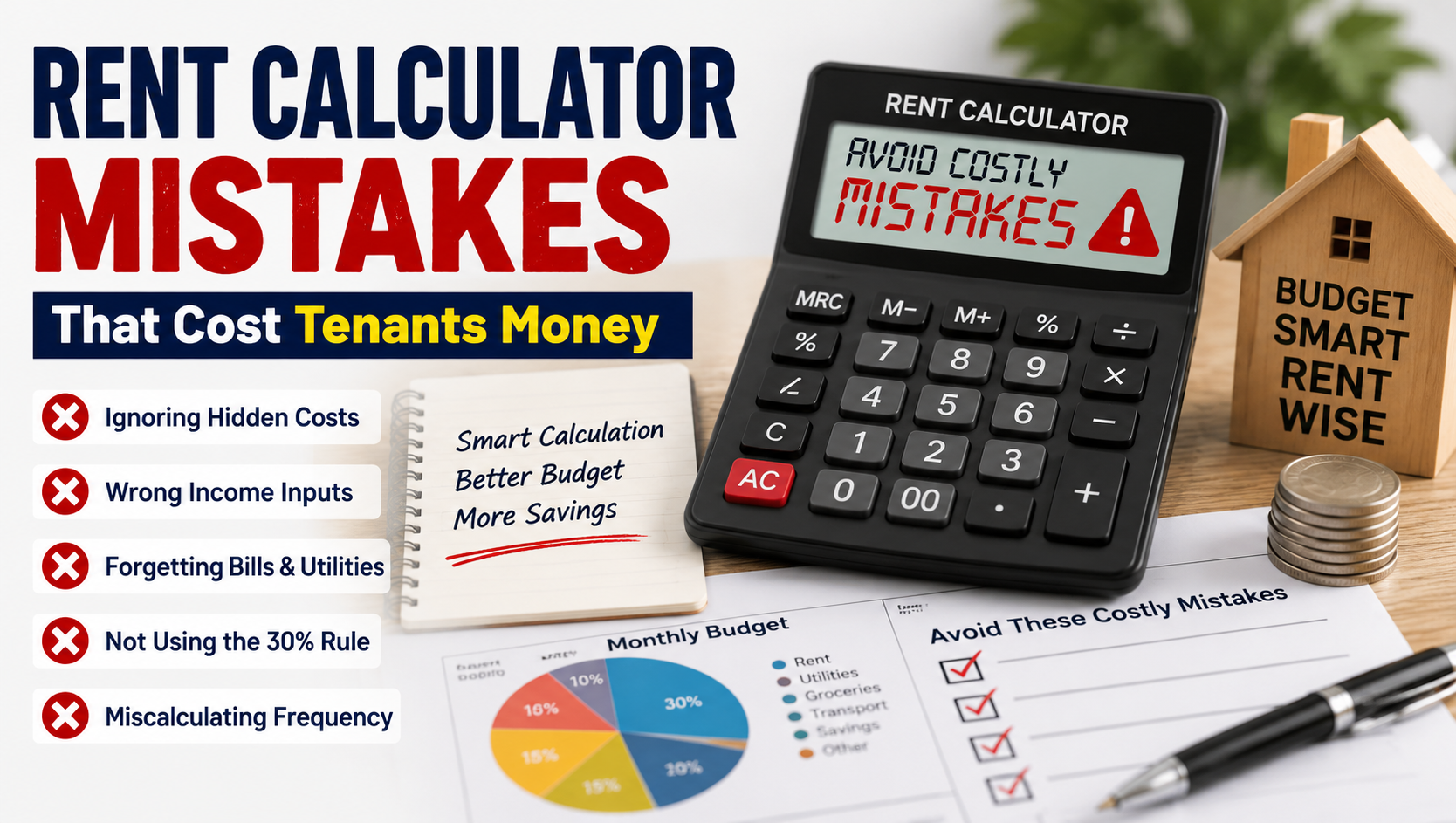
Finding a new place to live is exciting. There’s no denying that. New neighborhood, new walls to paint (or not, if your landlord’s strict about it), a fresh start of sorts. But somewhere between “this apartment has such good light” and “wait, can I actually afford this,” most people end up staring at a rent calculator, typing in a few numbers, and hoping for the best(Rent Calculator Mistakes).
And that’s kind of the problem, isn’t it? People hope the number is right instead of actually checking whether it’s right(Rent Calculator Mistakes).
A rent calculator can be a genuinely useful tool. It’s supposed to save you from signing a lease you’ll regret six months later. But here’s what nobody tells you when you’re excitedly scrolling through apartment listings at 11pm: the calculator only knows what you tell it. If you feed it half the story, it hands you back half the truth, dressed up to look complete. And a lot of tenants , smart, careful people , end up making the same handful of mistakes over and over again, mistakes that quietly cost them real money over the life of a lease.
So let’s actually go through them. Not in a lecture-y way, just… honestly, the way you’d want a friend who’s been through it to walk you through it.
Visit now:https://rentcalcpro.com/
Why This Even Matters (Rent Calculator Mistakes)
Quick tangent before we get into the list. Why does any of this matter beyond “budgeting is good, mkay”?
Because rent isn’t a one-time purchase. It’s not like buying a jacket where if you overspend a little, you shrug and move on. Rent is a recurring commitment , every single month, for the length of your lease, and often beyond, since most people don’t move every year. If your initial math was off by even a little, that error doesn’t just happen once. It happens twelve times a year, every year, until you fix it or move.
That’s the part people underestimate. A $150-a-month miscalculation doesn’t feel like much in isolation. Over a year, it’s $1,800. Over a two-year lease, it’s $3,600. Suddenly that “small” mistake isn’t so small(Rent Calculator Mistakes).
Okay. Let’s get into it.
Mistake #1: Using Gross Income Instead of Net Income
This is, hands down, the most common mistake , and honestly(Rent Calculator Mistakes), it’s not really the tenant’s fault most of the time. Most rent calculators just ask “what’s your annual income?” and people type in their salary. Gross salary(Rent Calculator Mistakes). The number on the offer letter, not the number that actually shows up in their bank account.
Here’s the disconnect: the famous 30% rule , rent shouldn’t be more than 30% of your income , was never meant to apply to your gross income. It’s supposed to be 30% of what you actually take home after taxes, health insurance, retirement contributions, all of it(Rent Calculator Mistakes).
So say someone makes $60,000 a year. On paper, 30% of that is $1,500 a month for rent. Feels doable, right? But once you subtract taxes and deductions, their real take-home might only be $3,800 a month, not $5,000. Thirty percent of that is closer to $1,140. That’s a $360 gap. Every single month(Rent Calculator Mistakes).
You can see how that plays out. Rent that “should” have been comfortable ends up eating into grocery money by the third week of the month, and the tenant has no idea why, because the calculator said this was fine.
What to do instead: Use your actual take-home pay. Check your last few paystubs, average them out if your income varies, and use that number , not the one on your résumé(Rent Calculator Mistakes).
Mistake #2: Forgetting Utilities Are Part of the Real Cost(Rent Calculator Mistakes)
I get why this happens. Rent calculators are built around one number , rent , because that’s the headline figure everyone’s trying to solve for. But rent is never really the full monthly housing cost. Electricity, gas, water, trash, internet, sometimes parking, sometimes a pet fee if you’ve got a dog or cat(Rent Calculator Mistakes).
None of that shows up in a basic calculator. And the tricky part is, it doesn’t bite you right away. Your first month in a new place, especially if you move in spring or fall, might feel totally manageable(Rent Calculator Mistakes). Then summer hits, or winter hits, and your utility bill triples because the unit has old windows or a cranky HVAC system, and now you’re wondering where all your money went.
Utilities alone can realistically add $150 to $400 a month depending on the climate and the size of the place. That’s not a rounding error. That’s a real chunk of your budget that a lot of tenants just… don’t plan for(Rent Calculator Mistakes).
What to do instead: Ask the landlord or current tenants what a typical utility bill looks like for that specific unit , not the neighborhood average, the actual unit. Add that number in manually since most calculators won’t ask(Rent Calculator Mistakes).
Mistake #3: Skipping Renter’s Insurance Entirely
This one’s almost funny because renter’s insurance is genuinely cheap , usually $15 to $30 a month , and yet it’s one of the most commonly forgotten line items in any rent budget. People just don’t think about it until a landlord requires it as a lease condition, and by then it’s a surprise expense they didn’t budget for(Rent Calculator Mistakes).
It’s a small number on its own. But when you’re already calculating things down to the dollar, “small” numbers you forgot to include have a way of adding up in ways that quietly throw off the whole plan(Rent Calculator Mistakes).
What to do instead: Just build it in from the start. Even if you haven’t picked a specific policy yet, put a conservative estimate into your monthly budget so there’s no surprise later(Rent Calculator Mistakes).
Mistake #4: Not Planning for Rent Increases
Here’s a mistake that doesn’t hurt you today. It hurts you next year.
Most tenants run their rent calculator once , right at the start, when they’re apartment hunting , and then never touch it again. But leases aren’t frozen in time. A lot of them include clauses allowing annual increases, and even the ones that don’t, landlords very often raise the rent at renewal to match whatever the market’s doing at that point.
So if you calculated your affordability based on today’s rent, and didn’t leave any room for a 3-8% bump next year, you might find yourself in a spot where renewing the lease suddenly feels tight in a way it never did before. And moving isn’t exactly cheap either , deposits, application fees, a moving truck, the whole ordeal.
What to do instead: Don’t sign at the exact ceiling of what a calculator says you can afford. Leave yourself room. If it says $1,400 is your max, aim for something meaningfully under that so a future increase doesn’t push you over the edge(Rent Calculator Mistakes).
Mistake #5: Assuming the 30% Rule is a Law
It came from a much older set of assumptions about income and cost of living, assumptions that, frankly, don’t hold up as well in a lot of cities today where rent has grown way faster than paychecks have. Someone with hefty student loans or childcare costs might find that even 30% leaves them stretched thin. Someone with zero debt and a paid-off car might comfortably handle more than 30% without blinking(Rent Calculator Mistakes).
Applying the same percentage to every single person, regardless of their actual financial situation, is a bit like handing everyone the same size shoe and telling them it’ll fit fine.
Mistake #6: Ignoring Debt-to-Income Ratio
This one connects directly to the mistake above. A rent calculator usually just compares your income to the rent amount. It doesn’t ask “hey, how much of your paycheck is already going toward a car loan or credit card debt or student loans(Rent Calculator Mistakes)?”
And that matters. A lot. Two people earning identical salaries can have completely different real-world rent budgets, purely because one of them is carrying significant debt payments every month and the other isn’t. If the calculator doesn’t account for that, it’s giving you a technically-correct-but-practically-useless number(Rent Calculator Mistakes).
What to do instead: Subtract your monthly debt payments from your income first. Then calculate affordability based on what’s actually left, not your full paycheck before other obligations are paid(Rent Calculator Mistakes).
Mistake #7: Forgetting About Move-In Costs
Everyone’s so laser-focused on the monthly number that the upfront costs of actually moving in get completely overlooked. Security deposit. First and last month’s rent, in some cases. Application fees(Rent Calculator Mistakes). A moving truck. Maybe some furniture because your old couch doesn’t fit the new layout.
None of that shows up in a monthly rent calculator, because it’s not a monthly cost , it’s a one-time hit. But it can be a big one. Big enough to wipe out savings or push someone onto a credit card right at the start of a new lease, which then makes every month after that feel tighter than it should.
What to do instead: Calculate move-in costs completely separately from your monthly budget, and make sure that money is actually saved before you sign anything(Rent Calculator Mistakes).
Mistake #8: Not Accounting for Irregular or Seasonal Expenses
Life doesn’t happen in neat, predictable monthly installments. Car repairs pop up. Holiday spending happens every December whether you planned for it or not. Medical bills show up uninvited. Annual subscriptions renew(Rent Calculator Mistakes).
None of this fits into a rent calculator’s monthly-only view of the world, but it’s still real money leaving your account, and if you don’t account for it somewhere, it’ll blindside you during the exact month it happens , usually the month you can least afford a surprise(Rent Calculator Mistakes).
What to do instead: Add up your rough annual total for these irregular costs, divide by twelve, and treat that as a hidden monthly line item when you’re calculating what rent you can actually handle(Rent Calculator Mistakes).
Mistake #9: Trusting Generic Averages Instead of Local Numbers
A lot of calculators fill in the blanks using national or regional averages , average utilities, average insurance, average moving costs. Useful as a rough starting point, sure. But not always accurate for your specific city, let alone your specific building(Rent Calculator Mistakes).
Someone moving to a genuinely expensive city might use a calculator built around national averages and end up dramatically underestimating what things actually cost there. It’s not that the calculator is lying to you exactly , it’s just speaking in generalities when your situation is very specific.
What to do instead: Swap in real, local numbers wherever you can. Ask current tenants in the building. Look up actual utility rates for that area. Generic averages are a starting point, not a final answer(Rent Calculator Mistakes).
Mistake #10: Never Recalculating After Life Changes
Probably the sneakiest mistake on this list, because it’s not really about the math being wrong at the start , it’s about never updating it later.
Life doesn’t stay still. You get a raise. You lose a job. You have a kid. You take on new debt. A partner moves in, or moves out. Every one of these should be a trigger to sit back down and redo the math, but most people run the numbers once, at the very beginning, and don’t look at them again until it’s time to renew the lease or move somewhere new(Rent Calculator Mistakes).
What to do instead: Set a reminder , every six months, or whenever something major shifts , to rerun your numbers with updated income, debt, and expenses.
Mistake #11: Comparing Rent, Not Total Cost of Living
An apartment $200 cheaper out in the suburbs might sound like a win , until you add in the extra gas, tolls, and wear and tear on your car from a longer commute, which could easily be $150 a month or more. Suddenly that “cheaper” place isn’t cheaper at all. The cost didn’t disappear. It just moved to a different line item.
Rent calculators aren’t built to make this comparison. They answer one narrow question , can you afford this rent , not the broader question of which option actually costs less overall.
What to do instead: When comparing places, look at total monthly cost of living for each , commute, groceries, parking, eating out because the kitchen’s too small to cook in , not just the rent line.
Mistake #12: Calculating Right Up to the Edge, With No Buffer
A calculator will tell you your technical maximum. It won’t tell you what happens the month your car needs a new alternator, or your hours get cut at work, or a medical bill shows up out of nowhere(Rent Calculator Mistakes). A lot of tenants calculate their budget right up to that maximum and leave zero room for anything going wrong.
And things do go wrong. Not always, not constantly, but often enough that “affordable on paper” and “actually sustainable” aren’t the same thing.
What to do instead: Treat whatever number the calculator gives you as a ceiling, not a target. Sign for something below that, and use the gap to build an emergency cushion.
Mistake #13: Never Understanding the Math Behind the Number
Last one, and honestly maybe the most important(Rent Calculator Mistakes). A lot of tenants treat rent calculators like a black box , type numbers in, trust whatever comes out, never ask why. But if you don’t understand the logic behind the calculation, you can’t tell when it’s wrong for your situation, and you definitely can’t adjust it.
People who understand the basic math , income, minus debt, minus fixed costs, times a reasonable percentage for housing , are simply in a stronger position than people who just trust the output blindly(Rent Calculator Mistakes).
What to do instead: Spend ten minutes figuring out how the calculator actually reaches its number. Once you know the formula, you can plug in your real numbers instead of relying on whatever defaults it assumed(Rent Calculator Mistakes).
A Quick Real-World Example (Because Numbers Are Easier With Context)
Let’s put a face on this, even a hypothetical one. Say Sarah makes $55,000 a year and finds an apartment listed at $1,350 a month. She plugs her gross salary into a basic rent calculator, and it tells her she’s well within the safe zone , great, sign the lease, move on with life.
Except her actual take-home pay, after taxes and a modest 401(k) contribution, is closer to $3,400 a month. She’s also paying $220 a month toward a car loan and another $150 toward student loans. Add in $200 for utilities she never checked on, $25 for renter’s insurance she forgot about, and suddenly that “safe” $1,350 rent is eating almost 45% of what she actually has left over after debts(Rent Calculator Mistakes) , not the comfortable 30% the calculator implied.
None of these individual numbers are dramatic on their own. But together, they tell a very different story than the one the calculator told her at first glance. This is exactly the kind of gap that catches people off guard three or four months into a lease, when the “affordable” apartment suddenly doesn’t feel affordable at all, and they can’t quite figure out why. It’s not that Sarah did anything unusually careless , she did exactly what most people do. She just didn’t know which numbers actually mattered(Rent Calculator Mistakes).
Why All These Small Mistakes Add Up to a Big Problem
None of these mistakes feel huge on their own. What’s a few hundred dollars a year in unaccounted utilities? What’s the harm in using gross income just this once for a quick estimate? But stack them together , gross income instead of net, no buffer for increases, ignored utilities, forgotten insurance, no room for irregular expenses , and the gap between (Rent Calculator Mistakes)”what the calculator said” and “what’s actually true” grows fast. Faster than most people expect.
This is really why so many tenants end up feeling squeezed even when their rent, on paper, looked totally reasonable. It’s almost never one single mistake causing the stress(Rent Calculator Mistakes). It’s the pile-up of small oversights, quietly working against you until the budget just… stops working.
Doing It Right: A Quick Recap
Start with real take-home pay, not your salary before deductions(Rent Calculator Mistakes). First subtract your existing debt payments since that money is already allocated. Provide realistic utility estimates for the specific unit, not a generic average. Renter’s insurance is a small one but include it as a fixed cost. Build in room for future rent increases instead of maxing out today’s number. Set aside a monthly average for irregular annual expenses. Budget separately for move-in costs(Rent Calculator Mistakes). And revisit all of it periodically, because your life keeps changing whether your rent calculator remembers to or not.
Read more:Rental Application Tips: How to Stand Out in a Competitive Market(Rental Application Tips)
Conclusion
Rent calculators are useful. Genuinely(Rent Calculator Mistakes). Nobody’s saying throw them out. But they’re only as good as what you put into them, and the mistakes covered here aren’t really about the tools being broken , they’re about how easy it is to cut corners while using them, whether that’s out of habit, being in a rush, or just not knowing better yet(Rent Calculator Mistakes).
The gap between a rent budget that actually holds up and one that quietly falls apart usually comes down to exactly these details , net versus gross income, hidden utilities, forgotten insurance, ignored increases, irregular expenses nobody planned for. None of it is complicated to fix once you know where to look(Rent Calculator Mistakes).
So next time you’re running the numbers, slow down a little. Use real figures instead of guesses wherever you can, leave room for the unexpected, and remember , the goal isn’t just finding a place you can afford today. It’s finding one you can still comfortably afford twelve months from now, without the stress creeping in by month four or five. That extra bit of care upfront is what actually protects your money , not the calculator itself(Rent Calculator Mistakes).
FAQ;s
1. Are rent calculators actually accurate, or are they just a rough guess?
They’re accurate for what they’re designed to do , basic math based on the numbers you enter. The inaccuracy almost always comes from the inputs, not the tool itself. Feed it real, honest numbers and it’ll give you a solid starting point. Feed it your salary before taxes or skip the utility field, and the output will look confident while being quietly wrong.
2. Should I use a different rent calculator for different cities?
Ideally, yes, or at least adjust the assumptions manually. A calculator built with national averages baked in won’t reflect the reality of a high-cost city versus a smaller town. If you’re moving somewhere with a very different cost of living than where the tool was designed for, treat its default numbers as a rough sketch, not gospel.
3. Is it better to use a rent calculator before or after touring apartments?
Before, ideally, so you walk into tours with a realistic budget in mind instead of falling in love with a place first and rationalizing the numbers afterward. That said, it’s worth rerunning the numbers again after a tour, once you know the actual utility setup, parking situation, and any building-specific fees.
4. Can a rent calculator tell me if I qualify for an apartment, or just what I can afford?
Just affordability. Landlords often use their own screening criteria , commonly requiring income to be around three times the rent , which is a separate check from whether the rent fits comfortably into your personal budget. You can pass a landlord’s income requirement and still be financially stretched, so don’t confuse the two.
5. What income should I use if I’m self-employed or have irregular pay?
Average your income over the last 6 to 12 months rather than using your best month or a projected future income. Self-employed income tends to fluctuate, and calculating affordability based on an optimistic month can set you up for trouble during a slower one.
6. Do rent calculators account for roommates splitting the cost?
Most basic calculators assume a single household income against a single rent figure, so if you’re splitting rent with roommates, you’ll need to manually divide the total rent and shared expenses before entering numbers, or the tool will assume you’re covering the full amount alone.
7. How often should rent realistically be recalculated during a lease?
At minimum, every six months, and immediately after any major income or expense change. Waiting until renewal time means you’re reacting to a problem instead of catching it early.
8. Is it normal for calculators to give different “safe” rent amounts depending on which one I use?
Yes, and it’s usually because they’re built around slightly different assumptions , some use net income, some use gross, some include debt ratios, others don’t. That’s exactly why understanding the logic behind a calculator matters more than trusting any single number blindly.
9. Should I include a partner’s or roommate’s income in the calculation?
Only if that income is reliably going toward shared housing costs and you’re confident it’ll continue. Combining incomes can make a place look more affordable than it actually is for you individually if that arrangement changes down the line.
10. Do rent calculators factor in credit score or rental history?
No, calculators focus purely on affordability math. Credit score and rental history affect whether a landlord approves your application, which is a completely separate hurdle from whether the rent itself fits your budget.
11. What’s a reasonable percentage of income to spend on rent in an expensive city?
There’s no universal number, but many financial planners suggest that in high-cost areas, 35-40% isn’t unusual, provided debt is low and other expenses are tightly managed. It’s less about hitting a magic percentage and more about what’s left over after rent for savings, debt, and daily life.
12. Can a rent calculator help me negotiate rent with a landlord?
Indirectly, yes. Knowing your real affordable range gives you a clear number to negotiate toward instead of guessing, and it helps you recognize quickly whether a landlord’s asking price is genuinely out of reach or just slightly above what feels comfortable.
13. Should students or first-time renters use the same calculators as everyone else?
The same tools work, but first-time renters often need to be extra careful about including things like renter’s insurance, utility setup fees, and moving costs, since these are easy to overlook when you’ve never budgeted for housing before.
14. Do rent calculators account for rent-controlled or subsidized housing differently?
Not usually , most standard calculators assume market-rate rent. If you’re looking at rent-controlled, subsidized, or income-restricted housing, the affordability math often works differently, and it’s worth checking directly with the housing program for accurate guidance rather than relying on a generic tool.
15. Is it worth paying for a premium or more detailed rent calculator app?
Only if it genuinely accounts for more variables , debt, irregular expenses, local cost-of-living data , than a free version. Otherwise, a free calculator combined with your own manual adjustments for the mistakes covered above will get you just as accurate a result.