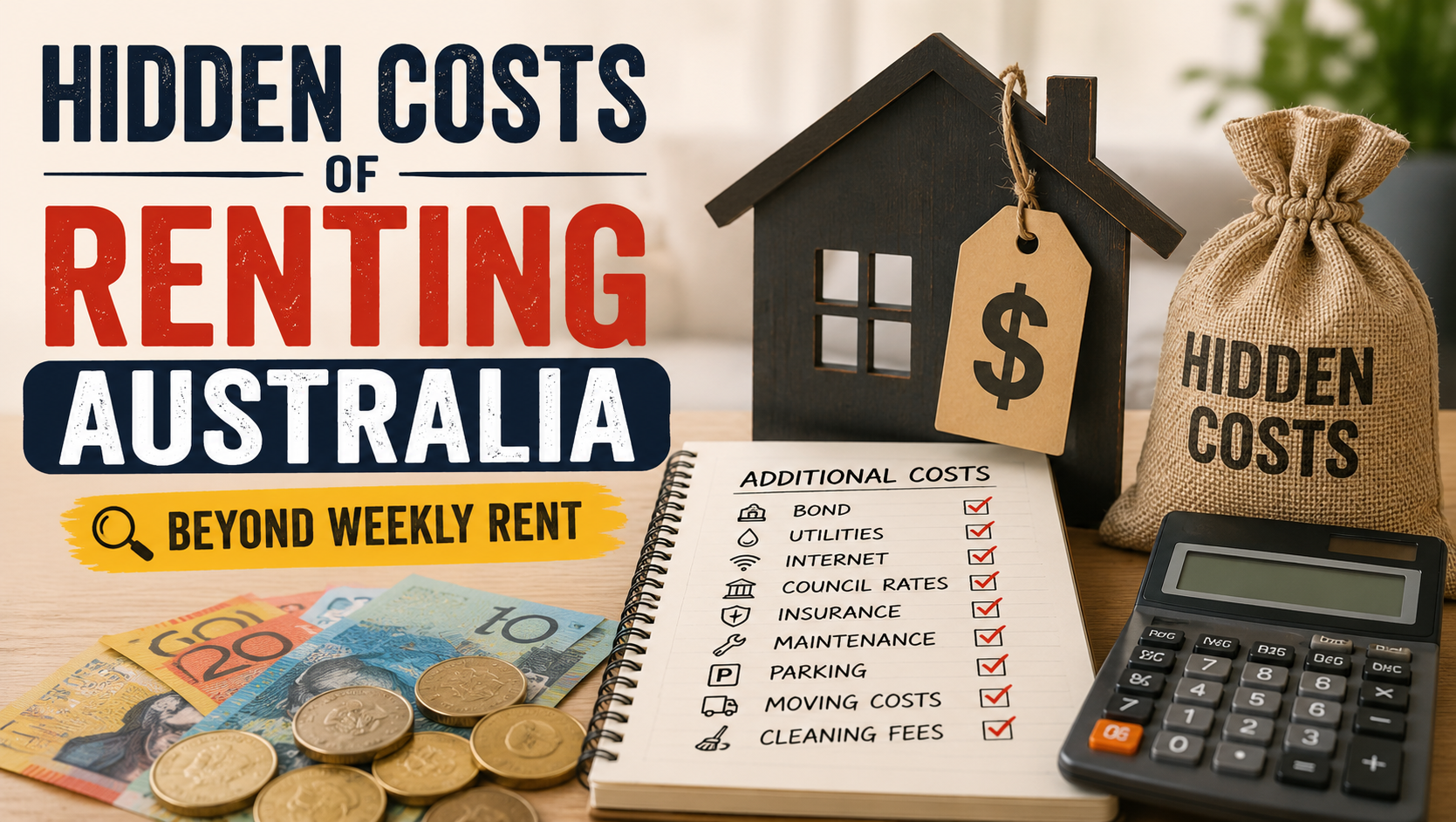
When people start looking for a place to rent in Australia they usually think about one thing: how much the weekly rent is. They do not think about all the costs that come with renting. The weekly rent is what people see first so that is what they focus on. Renting in Australia can be expensive.(Hidden Costs of Renting Australia). The weekly rent is just the beginning. People need to think about the hidden costs of renting in Australia, not the weekly rent. It’s the figure plastered across every listing, the thing you compare between properties, and the number you mentally check against your budget before you even click “apply.”
But here’s what almost nobody tells you until you’re already signing the lease: weekly rent is just the headline cost. By the time you’ve actually moved in and settled, you’ve usually spent a fair bit more than that one number ever suggested. None of these extra costs are secret exactly, but they’re scattered, easy to underestimate individually, and they tend to hit all at once right when your bank account is already under pressure from moving.(Hidden Costs of Renting Australia)
Let’s go through exactly what those hidden costs are, what they typically cost, and how to plan for them so they don’t catch you off guard.
Visit now:https://rentcalculatorpro.com/
Upfront Costs Before You Even Get the Keys.(Hidden Costs of Renting Australia)
Rent in advance
Most landlords don’t just ask for your first week’s rent. It’s common to be asked for two to four weeks’ rent paid in advance before you’re handed the keys. Combined with your bond, this single requirement can easily run into a couple of thousand dollars before you’ve even moved a single box.(Hidden Costs of Renting Australia).
The rental bond
In most states, the bond is capped at four weeks’ rent, though this varies depending on where you live and how much your weekly rent is. If your rent is $500 a week, that’s an extra $2,000 due upfront, on top of the advance rent.(Hidden Costs of Renting Australia).
Application or option fees
In some cases, you may be asked to pay a small, non-refundable fee just to have your rental application processed, which usually covers things like a credit check. This typically sits somewhere between $50 and $100. It’s not huge, but it’s an easy one to forget about, especially if you’re applying for several properties at once.(Hidden Costs of Renting Australia).
Moving Costs That Add Up Fast.(Hidden Costs of Renting Australia)
Removalists or truck hire
Depending on how much stuff you have and how far you’re moving, professional removalists in Australia can cost anywhere from a few hundred dollars for a short, simple move to several thousand if you’re relocating between states or have a large household to shift.(Hidden Costs of Renting Australia). Even a DIY approach with a hired truck and your own labour isn’t free once you factor in fuel and hire fees.
Packing supplies
Boxes, tape, bubble wrap, and furniture covers might seem minor, but they add up quickly, especially if you’re buying everything new rather than sourcing secondhand boxes.
Storage costs
If your move-out date and move-in date don’t line up perfectly, which happens more often than you’d think, you may need short-term storage for your belongings. This is an easy cost to overlook until you’re suddenly stuck needing it.
Utility Connection Fees Nobody Warns You About
This is one of the most consistently underestimated costs of moving into a new rental. Setting up electricity, gas, and internet at a new address almost always involves some kind of connection fee, and the amounts vary more than you’d expect depending on where you live..(Hidden Costs of Renting Australia)
For electricity, connection fees can range from roughly $11 in Queensland up to more than $80 in the ACT, depending on your distributor. Gas connection fees follow a similar pattern, starting from around $7 in some Victorian areas and climbing close to $56 in New South Wales. Internet providers often waive setup fees as part of new customer deals, but not always, so it’s worth checking before you assume it’s free.
On top of the official connection fees, there’s also the simple cost of needing your gear (modem, cables, adapters) to actually get everything running, plus the few days you might go without internet while a technician visits or hardware ships out..(Hidden Costs of Renting Australia)
The Recurring Bills That Catch People Off Guard
Once you’re settled, the ongoing monthly costs start rolling in. Even if you budgeted carefully for rent itself, these recurring expenses are often where people feel the real squeeze.
Water
Many Australian rentals don’t pass water charges directly onto tenants, but where they do, budget roughly $100 a month, particularly if the property has its own water meter.
Internet
Expect somewhere in the range of $70 to $100 a month for a decent home internet plan, depending on speed and provider.
None of these are unusual costs, but when you stack electricity, gas, water, and internet together, you’re often looking at a few hundred extra dollars a month that didn’t show up anywhere near the weekly rent figure you compared properties on.
Read more:The Simple Formula Behind Rent Conversion Calculators
Costs That Are Easy to Forget Entirely
Contents insurance is something that people often forget about. It is tempting to skip this when you are moving and money is tight.. Contents insurance is really worth the small cost.(Hidden Costs of Renting Australia).
If you have a pet you will have to pay more to live in a place that allows pets. Some places charge a one-time fee for pets and others add an amount to your rent each week. Some states even let landlords charge a pet bond on top of the regular bond.
When you move out you will have to clean the place. Many leases say you have to have the place professionally cleaned before you can get your bond back. Some cleaning companies promise that if you do not get your bond back you do not have to pay them. This is something to think about if you’re worried about problems when you move out.
If you are moving into a place that’s empty you will have to buy furniture and other things.
It is not too expensive. You should also think about update your address with your bank, employer and other people. This does not usually cost money. It can take some time..(Hidden Costs of Renting Australia)
A Realistic Example
Lets say you are renting a place for $550 a week. You will have to pay a bond, which’s usually four weeks rent. This is $2,200. You will also have to pay rent in advance, which can be two to four weeks. This is $1,100 to $2,200. Then there are the costs of connecting utilities like electricity, gas and internet. This can be $100 to $250. You will also have to pay to move your things, which can be $300 to $2,000 or more.. Then you will have to pay for utilities for the first month, which can be $250 to $400.
All of these costs can add up to a lot of money. Even if you are paying the amount it can be over $4,000.. If you are moving a long way it can be even more. These costs are not unusual. They can all happen at the same time, which can be a problem.
How to Plan Ahead for These Costs.(Hidden Costs of Renting Australia)
You should make a budget for moving, not for rent. Before you sign a lease you should think about all of the costs. Make a list. This way you will know how money you really need. You should also ask about utilities before you sign a lease. Some places include utilities in the rent so it is an idea to check.(Hidden Costs of Renting Australia)
You should compare utility providers before you choose one. There are services that can help you find the best deal. You should also set aside a money each week for bills. This way you will not be surprised when the bills come.
Do not skip contents insurance to save money. It is one of the ways to protect yourself financially and it is worth it in the long run.
Conclusion
The weekly rent is the beginning. You have to think about all of the costs like bonds, advance rent, connection fees moving costs, insurance and utilities. These costs can add up to a lot of money(Hidden Costs of Renting Australia). If you plan ahead you can handle them. Renting a place in Australia is not too expensive if you are smart, about it. You just have to think about all of the costs and plan ahead.
1. Are landlords required to disclose all extra costs before I sign a lease?
Landlords and agents are generally required to disclose key fees like bond and advance rent upfront, but smaller costs like utility connection fees aren’t something they’re obligated to walk you through(Hidden Costs of Renting Australia).
2. Can a landlord charge me for normal wear and tear when I move out?(Hidden Costs of Renting Australia)
No. Reasonable wear and tear, like minor carpet fading or small marks from everyday living, isn’t something landlords can charge for or deduct from your bond.
3. Is it normal to pay both an application fee and a holding deposit?
This varies by state and property. Some agents charge a small application fee(Hidden Costs of Renting Australia), while others may ask for a holding deposit to reserve the property, but both at once isn’t standard practice everywhere.
4. Do all rentals require contents insurance, or is it optional?
Contents insurance is optional in most cases, not legally required, but it’s strongly recommended since your landlord’s insurance won’t cover your personal belongings.(Hidden Costs of Renting Australia)
5. Why do utility connection fees vary so much between providers?
Connection costs depend on your distributor, your location, and sometimes whether the property already has an active connection versus needing a brand-new one set up.(Hidden Costs of Renting Australia)
6. Can I avoid paying a connection fee if the previous tenant already had utilities connected?
Sometimes. If the service is simply being transferred into your name rather than newly connected, the fee can be lower or occasionally waived, depending on the provider.
7. Is it common for share houses to split hidden costs differently than rent?
Yes(Hidden Costs of Renting Australia). Many share houses split rent evenly but divide bills based on usage or room size, so it’s worth clarifying this arrangement with housemates before moving in.
8. Do real estate agents earn a commission from connection or utility services they recommend?
In some cases, agents or relocation services do receive referral fees for utility connections, which is worth keeping in mind when comparing recommended providers against independent ones(Hidden Costs of Renting Australia).
9. Are pet bonds refundable like regular bonds?
Where pet bonds exist as a separate charge, they’re generally refundable too, provided there’s no pet-related damage at the end of the tenancy.
10. Can I negotiate who pays for end-of-lease cleaning?
This depends on what’s stated in your lease agreement. Some leases specify professional cleaning is the tenant’s responsibility, while others leave more room for discussion.
11. Do students or first-time renters face different hidden costs than long-term renters?
First-time renters often face higher relative costs since they’re furnishing a home from scratch, while long-term renters mostly deal with recurring bills and occasional bond top-ups.
12. Is it worth asking for bills-included rentals to avoid hidden utility costs?
It can be, especially for predictable budgeting, though bills-included properties sometimes come with slightly higher weekly rent to offset that convenience.
13. Are there hidden costs specific to renting in regional areas compared to cities?
Yes, regional renters sometimes face higher utility connection costs or limited provider choice, though rent itself is often lower than in major cities.
14. Can moving costs be claimed as a tax deduction in Australia?
Generally, no. Personal moving costs for a rental property aren’t tax-deductible, although certain work-related relocation expenses may be treated differently.
15. What’s the most commonly underestimated cost when renting for the first time?
Furnishing an empty property is often the most underestimated cost, since it’s easy to focus on rent and bond while forgetting how much basic furniture and kitchen items actually cost.
16. Do I need to pay for a final property inspection when moving out?(Hidden Costs of Renting Australia)
No, the landlord or agent typically arranges and covers the cost of the final inspection itself, though any issues found may affect your bond refund.
17. Are there hidden costs involved in renewing a lease compared to signing a new one?
Renewing usually avoids costs like a new bond or application fee, though some leases include administrative renewal fees, so it’s worth checking your specific agreement.
18. Can I be charged for minor repairs that aren’t my fault?
No, general maintenance and repairs unrelated to tenant damage are the landlord’s responsibility, not an additional cost you should be covering.
19. Do utility providers ever offer better deals for new renters specifically?
Yes, many electricity, gas, and internet providers run new-customer promotions, which can sometimes offset or completely waive connection fees if you time your sign-up well.
20. What’s the best way to track all these hidden costs so I don’t lose track of spending?
Keeping a simple moving and bills spreadsheet, listing every upfront and recurring cost as it comes up(Hidden Costs of Renting Australia), is one of the easiest ways to stay on top of expenses that would otherwise feel scattered and unpredictable.